
 Login
Login


A Year as EO Global Board Chair: At the Midpoint and Gaining Momentum
January 29, 2026
Published in:
Halfway through his year of service as EO Global Board Chair, Joaquin “Quini” Cordero reflects on what he has learned so far, the work that lies ahead, and the mark he hopes the Global Board can make during his tenure.
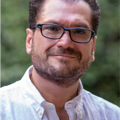
We have just crossed the midway point of the EO fiscal year, and I am feeling both grateful for the accomplishments behind us and enthusiastic for all that lies ahead. A few weeks ago, I visited India for South Asia’s Regional Integration Event — “RIEMAGINE” — hosted by EO Pune, and was blown away by the scale, the enthusiasm among the attendees, and the caliber of the speakers. I also met with leaders of six chapters across the country, and the South Asia Regional Council: The hospitality was unmatched and the energy reminded me why EO is so special. I flew home with a full heart and a long to‑do list.
Breaking my leg in July forced me to slow down and re‑center. It also softened the perfectionist voice in my head. Through the first half of my time as chair, I have learned to let go a bit, trust the system and the people around me, and invest my energy in a thoughtful way.
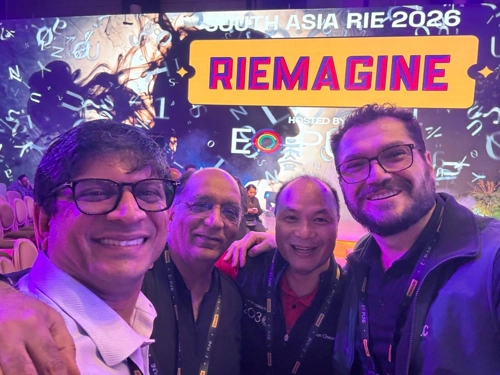
Quini (far right) and EO Global Board Director Alan Cheung (second from right)
with past Global Board Directors Sanjay Raghunath (left)
and Sanjay Wadhwa at the RIEMAGINE event.
A Strong Start
Beyond all the enriching opportunities to travel and meet EO members around the world, we have covered a lot of ground on the Global Board. I may be most excited about the idea of creating five new Board Advisory Committees (BACs). We are testing how they will function, and they will be comprised of current and past Global Board Directors. They are not operational committees, and they do not replace Councils, Portfolios, Standing Committees, or other bodies.
They will be a mechanism for the Global Board to better organize itself so we can more effectively fulfill our core responsibility: to protect and direct the organization across key oversight areas like finance, risk, strategy, governance, leadership development, technology, culture, and member value.
Historically, every one of these topics required the attention of the full Global Board. As EO has grown in scale and complexity, that approach has made it harder for the Global Board to be both proactive and responsive when issues arise. The BAC model solves this by allowing smaller groups of directors to dive deeper into specific oversight areas. It will help the Global Board be more agile, make better decisions, and stay focused on what matters most.
We have just begun a six-month soft launch period for the BACs, which will run through June: It is very intentionally designed as a learning period.
We have also been discussing ways to enhance the experience for our most longstanding and dedicated members. Those conversations are ongoing, but we are considering ways to reward and recognize members who have been with us for decades for their enduring commitment to the organization.
As I see it on a personal level, a chair’s job is to facilitate the board so that the staff and leadership can execute — and to keep the boardroom rigorous and relational. We have tough conversations inside meetings, then share laughs at dinner afterwards. That balance and energy matters as we seek to make decisions that benefit our fellow EO members.
The Work Ahead
When my tenure concludes later this year, I hope we can leave behind a Global Board equipped to move faster and that is more confident about where it needs to spend time and energy. I also hope we can use every gathering to model culture. Presidents’ Meetings, the Global Leadership Conference, and our in‑person Global Board meetings are our culture drivers. The tone we set at those key events and meetings, particularly leading with service rather than ego, cascades down into the culture of our chapters.
I believe that the “School of Presidents” model we have used in Latin America is a game changer. There, chapter presidents engage in a year-long program that blends inspiration and hands‑on training. I believe EO can adapt a model like that globally and provide more training and examples of what it means to have a high‑performing chapter board. Strong boards lead to stronger chapters which, in turn, lead to better member outcomes and experiences.
Perhaps most importantly, I hope we can continue moving the ball forward toward our 2030 strategic goal of 95 percent retention, which would enable EO to reach 35,000 members globally. Some regions — South Asia is a standout — are already operating near 99 percent renewal and experimenting family programming and pathways for the next generation of entrepreneurs. We hope to learn from what is working and translate the principles across regions.
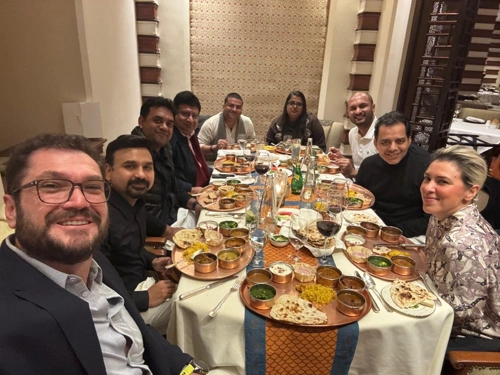
During his trip, Quini visited numerous EO chapters and met with member leaders
across India, including South Asia Regional Chair Uddhav Poddar (at right, black shirt).
At the Finish Line
Legacy is a paradox for any chair. You do not show up simply to “make your mark.” Yet you are asked to lead and offer a clear point of view. The balance I have tried to find is this: Make it easier for smart people to do their best work together — and leave behind mechanisms that outlast any individual contributor.
If, when my term is over, our Global Board is more efficient and more cohesive and our chapter leaders are better trained for the roles they hold, I will feel we have moved in the right direction.
On a personal level, I have learned to quiet the internal monologue, imposter syndrome, and self-doubt that often accompanies responsibility. I have learned that perfectionism is not leadership. Letting the right voices shape the right decisions has been freeing and effective. If our Global Board closes this year both productive and united — even after difficult discussions and decisions — that will be music to my ears. It will mean we honored EO’s culture of doing important work on behalf of our membership while simultaneously having fun.
When I was in India, a speaker at the event shared some wisdom that resonated with me: “This is no longer a world where the big eat the small; this is a world where the fast eat the slow.” Our responsibility as a Global Board is to ensure EO stays fast where it must be fast and to be deliberate when it is necessary. If we do that in these final months together, we will leave the next Global Board in an even stronger position to succeed. I have enjoyed every day in the role — but know the best is yet to come.
Joaquin “Quini” Cordero (EO Guatemala) is EO Global Board Chair and founder and president of Lumen, an advertising agency.
 More EO Member Insights

Finding Common Ground Across Continents
How global travel, vulnerability, and shared laughter taught EO Global Board Chair Joaquin “Quini” Cordero that entrepreneurs everywhere are linked by common drive and decency — no matter where they call home.

Lessons for Entrepreneurs Amid Personal Challenges
A climbing accident, surgeries, and battling a frightening infection taught EO Global Board Chair Joaquin “Quini” Cordero about the power of letting go, leaning on community, and seeing the big picture.

Conversations that Illuminate: How Podcasting Changed the Way I Learn and Lead
What began as a marketing project became a masterclass in curiosity, vulnerability, and personal growth.