
 Login
Login


Exiting via ESOP: How One Entrepreneur Embraced This Tax-Smart, Legacy-Building Alternative to Private Equity
February 23, 2026
Published in:
Tim Rettig (EO Cincinnati) watched his father build a software company — then give it to his employees. Two decades later, Tim did the same. Now he is on a mission to convince other business owners to follow his lead.

Tim Rettig (EO Cincinnati) will never forget the Monday morning in rural Texas when everything crystallized. It was 2007, and he had flown down from Cincinnati with his IT team to install new computers at his client’s manufacturing plant, which had just been acquired. What he did not know — and what the employees did not yet realize — was that the company had been sold the Friday before. Nobody had told them.
“They came in at seven o’clock asking us, ‘Who is our boss now? What about our 401(k)?’” Tim recalls. “I told them, ‘I am just the IT guy. I don’t know anything.’”
It turned out that the owner had taken the money and vanished. In fact, movers were already packing up his house. The employees, some of whom had worked there for 20 years and had been promised a chance to buy the company, were left to figure things out on their own.
A people person, Tim spent more time during that week in Texas learning about the staff than teaching them about computers. As he sat with those employees, listening to their stories, he made himself a promise that he would never put his own people through that.
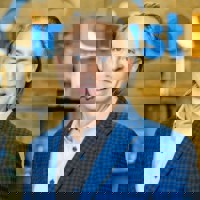 Tim Rettig (EO Cincinnati)
A Different Kind of Exit
Tim’s path to employee ownership started with his father. In 1978, his dad founded a software company in Lebanon, Ohio. Tim grew up around it, working part-time through grade school and high school. In 2001, his father had a stress-related heart attack — Y2K had taken its toll — and decided to exit. Instead of selling to private equity or a strategic buyer, he discovered an alternative: an Employee Stock Ownership Plan (ESOP).
With an ESOP, a trust buys shares from the owner on behalf of employees. Workers do not have to invest a dime or take on any risk; they simply earn ownership over time. The exiting owner avoids capital gains taxes, and the company becomes a non-taxable entity, freeing up cash to pay off debt and invest in growth.
Tim’s father exited in 2004. Twenty years later, the company is still thriving, still bears his name, and still employs many of the same people. In fact, his father is often invited to his former employees’ retirement parties.
“He gets to hear all the great things from people retiring in a much better place because of the benefits of working at that ESOP,” Tim says. “That is the legacy I wanted.”
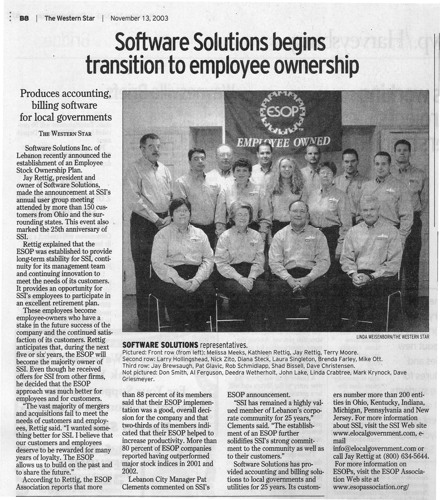 Tim's father's decision to exit the company via an ESOP made news —
and made a lasting impression on his son.
In 1992, while still in college, Tim started his own IT support company, eventually named Intrust IT. After witnessing the Texas debacle in 2007, he sat down with his dad and learned the mechanics of ESOPs. But his company was not ready. It was barely breaking even, too small, and he had partners who were not interested.
It took until 2012 to buy out his partners and reboot the company. Only then did Tim announce his intention to his employees: Intrust IT would become employee-owned.
Building Toward Ownership
The employees’ first reaction? We are not sure what that means.
It took a year of education — explaining how ESOPs work, sharing the Texas story, and introducing them to the history of Louis Kelso, the economist who invented the ESOP model in the 1950s. He explained that, unlike a management buyout, employees would not have to take on loans or risk. They just had to help grow the company to the size and profitability required for the transaction to work.
“Previously, I was growing and making acquisitions, and my employees would wonder, ‘Why are we doing this? This is all just for you?’” Tim says, “When I changed it and said, ‘The reason we have to get larger is that we want to become employee-owned,’ it became a different rallying cry.”

“Previously, I was growing and making acquisitions, and my employees would wonder, ‘Why are we doing this? This is all just for you?’ When I changed it and said, ‘The reason we have to get larger is that we want to become employee-owned,’ it became a different rallying cry.”
- Tim Rettig (EO Cincinnati)
In 2014, following his father’s advice to teach employees about the financials before the transition, Tim implemented the Great Game of Business, an open-book management system. Employees could see profits, costs, and how their work tied to the bottom line. A quarterly bonus program gave them a stake in near-term results, not just a distant retirement fund.
Intrust IT became 30 percent employee-owned in 2019. Then, in 2025 — five years ahead of his original goal — Tim completed a transaction that made the company 100 percent employee-owned through an ESOP holding company. This means that his employees now have ownership stakes in nineteen companies, not just one.
Tim stepped down as CEO at the end of 2025.
Life After the C-Suite
Tim joined EO via the Cincinnati chapter 13 years ago and eventually served as chapter president and regional member experience director, but it was the EO Global Speakers Academy that helped him find his next calling.
“It helped me craft my message and simplify what I was talking about,” he explains. He went to the Academy specifically to work on his messaging about employee ownership. He now speaks at universities, industry events, and EO chapters about employee ownership as a tax strategy and as a way to build companies that outlast their founders.
EO also helped Tim gauge the success of his sale. By talking with his peers in Forum, he has gotten to watch many of them sell their companies. That is why he knows that, through ESOP, his exit was about the same multiple of EBITDA as theirs. “But,” he explains, “I had the tax benefits, which actually created a better exit for me.”
EO also helped him set big goals. Now, his bucket list includes creating 10,000 employee owners, whether at his own companies or by convincing other entrepreneurs to choose ESOPs. He has tracked about 1,000 thus far: When Tim talks to owners who exited their companies via ESOP, “about 90 percent say it is the best decision they ever made,” whereas for “entrepreneurs who have sold to private equity or strategic buyers, it is about 50-50 whether they say it was good for employees, clients, or communities.”
Tim is firmly in the 90 percent. He still receives daily calls from private equity firms interested in buying companies like his, but he ignores them. He believes that the legacy he is building will pay off in ways that transcend money. The company will still have the same name. Many of the same people will still work there. Plus, 20 years from now, as the current owners follow him into their own well-funded retirements, he might get invited to a few parties — just like his dad.
Tim is currently working on his first book, “Exiting for Good,” forthcoming in 2027. Interested in becoming an EO member like Tim? Learn more here.
 More EO Member Journeys

True Grit: EO Members Band Together to Help Entrepreneurs Facing Tough Times
Ami Kassar realized fellow EO members facing financial difficulties needed help, so he started a WhatsApp group that became EO Grit, a global lifeline and fast-growing community for entrepreneurs confronting their biggest obstacles.

Glass Half Full: The Young Entrepreneur Who Refused to Throw Away a Good Idea
What began as Franziska Trautmann’s brainchild over a bottle of wine has grown into a booming recycling business that is helping restore Louisiana’s coast.

How Entrepreneurs’ Organization Helped Brian Scudamore Turn a Junk-Hauling Idea Into an International Powerhouse
From borrowing quarters for an empty parking meter to leading a near billion-dollar business, the 1-800-GOT-JUNK? founder credits his EO community for giving him a place to learn, grow, and give back.