
 Login
Login


From Housekeeper to CEO to Champion of Change
July 17, 2026
Published in:
Sherry Deutschmann (EO Nashville) grew her company to US$40M by sharing profits and treating every employee as essential. Now she is using that philosophy to help women build million-dollar companies.

Sherry Deutschmann grew up in the mountains of North Carolina, and by the time she was a young woman, she was certain of two things: she could sing, and Nashville was waiting for her. She moved there with her daughter and a head full of ambition, but soon discovered that being recognized in a small town and being recognized in Nashville were two very different things.
When the singing career did not come to fruition, she focused on survival. She cleaned gas station bathrooms, worked as a housekeeper for wealthy families, tended bar, and answered phones at a plumbing company. She often had to scrape pennies together just to put gas in the car. There were stretches when she could not pay both the daycare and the electric bills, so she and her daughter went without electricity.
She did have a talent for talking to people. Growing up as a Jehovah's Witness, she had been knocking on strangers' doors since she was eight years old. That turned out to be her way into sales, where she started making real money, bought a house, and began to get her footing. Eventually, she became vice president of sales for a healthcare services company that printed and mailed hospital bills for large healthcare systems nationwide.
Sherry was good at her job, but she kept watching the same painful cycle repeat itself: she would land a major account, and then the company would lose two others because the service was so poor. She felt that she knew why: the people doing the work felt invisible.
She went to her boss with an idea. If they actually took care of the people on the plant floor, those people would care about what they were doing. Her boss listened politely. Then he patted her hand. "You do not know anything about business, Sherry," he told her. "Why do you not just go sell something?"
So she did: For herself.
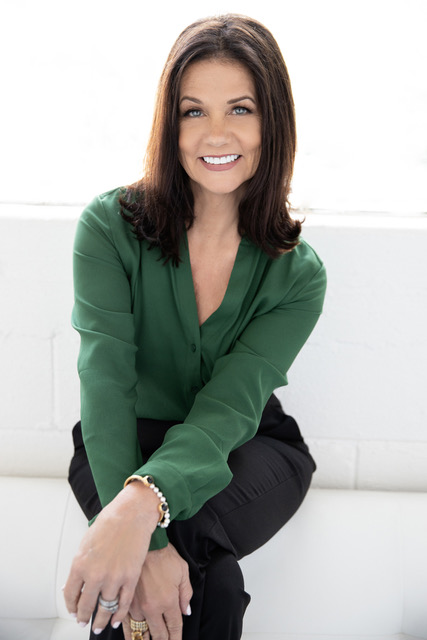 Sherry Deutschmann (EO Nashville)
Becoming “Oprah for a Day”
In 2002, at the age of 42, Sherry left and started LetterLogic, doing exactly what her former employer did: receiving raw data from large healthcare systems, parsing it, and printing and mailing the bills. She had no formal business education and, by her own admission, did not entirely know what she was doing. But she says, "I knew human nature. And knew that we have an innate desire to be seen. And to have a voice. And to be appreciated. And that is what I leaned into.”
She decided that at LetterLogic, employees would come first, not as a slogan, but as an operating principle with real dollar signs attached.
She covered 100 percent of employee health, dental, disability, and life insurance. She helped employees buy their first homes by gifting them money for down payments. She opened the books each month, gathering the entire staff and walking them through the previous month's financials. “This is how much we brought in,” she told them. “This is our profit. Here is what hurt us, and here is what we did right.” Then she took 10 percent of the monthly profit and distributed it equally among all employees, with the receptionist and the CFO receiving the exact same check.
"We were all equally important to the bottom line," she says.
The results were immediate and tangible. Employees stopped wasting time and materials once they understood that every dollar of waste came out of the profit share.
Soon, LetterLogic landed on the Inc. 5000 list of the fastest-growing privately held companies in America and stayed there for 10 consecutive years. Sherry made no apologies for her company being the most expensive option on the market. She told prospects, "If you are price sensitive, do not waste your time talking to us." Also, she told them, “We believe the customer does not come first. My employees do.” Then she would explain why this was all very good news for them. More than 80 percent of LetterLogic's sales, her team estimated, were what they called "culture sales" — healthcare systems choosing LetterLogic not on price but because they believed in how the company operated.
Meanwhile, Sherry became a member of EO Nashville. Her friend Wade Miller had been after her for years. "I joined just to shut him up, really," she jokes now. The time commitment felt impossible when she was building a company and raising a daughter. But once she was in, she understood what Wade had been talking about. The Forum model — the small, confidential peer group at the heart of the EO experience — turned out to be exactly the kind of structure she drew on while building LetterLogic. Her Forum group became lifelong friends. "We will be close until I die," she says.
She decided to sell LetterLogic in 2016, and the timing, she says, was "quintessential." Business had just quadrupled its EBITDA over an 18-month period. "It was the storybook example of when to sell a company," she says. By the time she sold, LetterLogic was processing more than 400,000 hospital bills a day.
True to form, she took 15 percent of the sale price and distributed it among her employees, with the amount for each scaled to their tenure. "It felt like being Oprah for a day," she says. The company sold with revenue of US$40 million.
A Book and a New Venture
After the sale, she wrote her book, “Lunch with Lucy,” named for the Wednesday ritual at LetterLogic where she shed her CEO title and became a coworker available for lunch. Any employee could sign up. They picked the restaurant, chose who came along, and set the topic. She just listened. "It was the most important time I spent growing that business," she says. "Because I got to hear about their hopes and dreams. And they had the best ideas for how to improve our company."
She also became an angel investor, eventually making 29 investments — 27 of them in women-owned businesses. That focus was not accidental. While serving on the National Women's Business Council in Washington, advising the president, Congress, and the SBA on issues affecting women in business, she kept encountering the same statistic: women receive only 2 percent of venture capital, despite data showing they deliver higher returns on investment. It made her furious.
Women started coming to her asking for mentorship. Her answer was always the same: join EO. The peer learning model was exactly what they needed. But then they would come back with the same problem: they did not meet the revenue requirement. Sherry learned that only about 2 percent of women-owned businesses ever reach a million dollars in revenue. There was a gap between where most women entrepreneurs were and where organizations like EO could serve them. She decided to fill it.
BrainTrust launched with a clear-eyed diagnosis of what women entrepreneurs actually need and what tends to get in the way. It has peer groups, called "vaults," a safe place for your most valuable things. They followed the Forum model she had come to trust through EO. Members meet monthly in small groups, share a brief on their business challenges, and hold each other accountable. But BrainTrust adds one discipline that Sherry considers non-negotiable: every member announces her revenue out loud at the start of each meeting.
"It is grounding," she says. "It requires a great deal of vulnerability. And it establishes that we are not here for socializing. We are here to build financial independence."BrainTrust keeps the focus on revenue and profitability, using technology to track each member's growth and put it front and center every time they log into the portal. The message is simple and unrelenting: if your revenue is flat, what are you going to do about it?
The organization currently operates in Atlanta, Charlotte, and Nashville, with a virtual option that connects women in the same industry. Sherry's goal is to be in 20 cities by 2030. She is in the final stretch of a US$7 million capital raise, with US$5.7 million committed, nearly all of it from women. BrainTrust serves members with revenue starting at US$100,000, with the first milestone being the million-dollar mark, which would make them eligible for EO.
Getting women there, she says, is the point.
Sherry Deutschmann is a member of EO Nashville and the founder and CEO of BrainTrust, a membership organization for women business owners. She is also the author of “Lunch with Lucy: Maximize Profits by Investing in Your Employees.” Interested in becoming an EO member like Sherry? Learn more here.
 More EO Member Journeys

A Founder Who Puts Wealth in the Hands of Women
Bhavya Kalsi (EO Uganda) did not set out to become a champion for female entrepreneurs. But after several businesses, two continents, two children, and one pandemic, she could not imagine doing anything else.

International Women’s Day Spotlight: A Conversation with EO’s Next Global Board Chair
EO Global Board Chair-Elect Taunya Renson-Martin (EO Belgium) shares lessons from her journey as an entrepreneur and actor, her thoughts on the power of Forum, and how the next generation of women entrepreneurs is poised to impact the world.

By Women, For Women: How One Entrepreneur Built a Business Where Women Can Thrive
What began as a quest for work-life balance for Tracy Marlowe (EO Sacramento) became a mission to empower women — and a blueprint for how a company can be both human and high-performing.