
 Login
Login


Glass Half Full: The Young Entrepreneur Who Refused to Throw Away a Good Idea
December 18, 2025
Published in:
What began as Franziska Trautmann’s brainchild over a bottle of wine has grown into a booming recycling business that is helping restore Louisiana’s coast.

The idea arrived as many half-formed notions do: almost accidentally, at night, and over a bottle of wine. In early 2020, Tulane University senior Franziska Trautmann (EO Louisiana) was enjoying a bottle with her boyfriend, Max Steitz, as they reflected on the reality that it would almost certainly end up in a landfill. New Orleans had no viable way to recycle glass: What, they wondered, if there were another option?
The answer to that question became Glass Half Full, a Louisiana-based recycling company they co-founded that transforms discarded glass into sand that can be used for coastal restoration and flood mitigation. It has proven to be a profitable business model in a region long underserved by traditional recycling systems. Franziska did not know it then, but that conversation over wine would steer the chemical engineering major’s life away from the steady career in research she envisioned and onto entrepreneurship’s unpredictable terrain. “When we started, we did not think this would become a big business,” she says.
Nearly six years later, Glass Half Full is a big business and, most importantly to Franziska, it is making a big impact on the region she has long called home. “The coastal restoration piece for me is definitely the thing I am most proud of,” she says. “I got a drone in the last few years, so I get to take before-and-after pictures. Just looking at those and seeing, oh, there was open water here and now it has transformed back into thriving wetlands and marshes that are filtering and absorbing toxins — that is just the best feeling ever.”
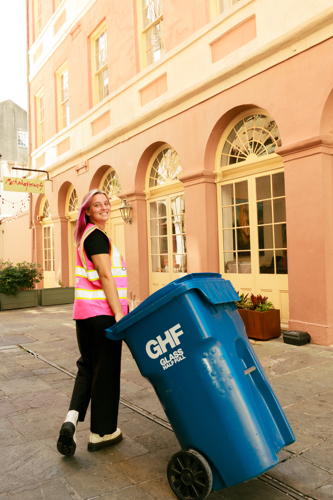 Franziska Trautmann (EO Louisiana)
One Bottle at a Time
Franziska’s journey started where anyone with an internet connection’s would have: “We were Googling, ‘How do you recycle glass?’”
The duo found a small machine capable of pulverizing glass bottles into sand — one at a time. They began by collecting glass from friends and locals, hand-crushing bottles with no clear endgame in mind. While Franziska expected early support to come primarily from fellow students, the broader New Orleans community showed the most interest. What seemed to resonate most was the promise of transparency and impact. “A lot of people seem to be fed up with traditional recycling — they do not see what happens to it.” Franziska says. “They were like, ‘This is something new and different that I can see has value.’”

“EO has been by far the best investment I think we have made in our personal development and growth as leaders."
- Franziska Trautmann (EO Louisiana)
Just weeks after officially launching in early 2020, the world shut down. COVID-19 threatened to end the company almost as soon as it began. Concerns about safety and contamination emerged overnight. Instead of retreating, the team pivoted, introducing residential glass pickups to reduce contact and keep material flowing.
Still, it was a young business that seemed imperiled by the pandemic. The breaking point came when a massive backlog of glass overwhelmed their operation, which still relied on its small-but-mighty, one-bottle processing machine. Then, serendipitously, help arrived. Mike Rowe of “Dirty Jobs” television fame and his team discovered Glass Half Full on TikTok, visited the company, and handed them a US$35,000 check to help them purchase a larger machine.
“Before that we were like, ‘We are done; we are cooked,” Franziska says. “And then, ‘Here is a check.’ Things like that just kept happening. We thought we were done and then something would happen and things would turn around.”
Thanks to that investment, the company stabilized. That foundation has since helped Glass Half Full expand into Mississippi and Alabama. “There were so many small wins over that time, but there was never this big ‘we made it’ moment,” she says. “But I do often look back and think, ‘Wow, we have done a lot.’”
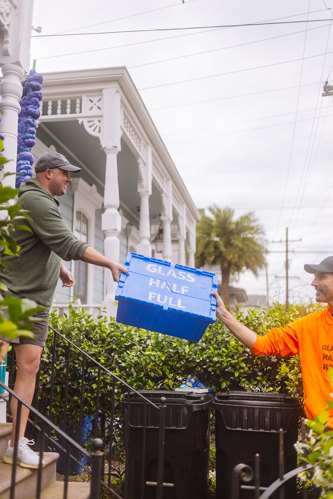
Residential pickup is core to Glass Half Full's business model.
Sustaining a Business – and the Environment
What matters most to her now is not scale for its own sake, but the tangible environmental impact the company makes every day. Glass Half Full now processes glass in a 10,000-square-foot warehouse facility in Chalmette, Louisiana. The massive new machinery inside transforms recycling waste into sand used for coastal restoration, wetland rebuilding, flood mitigation, and a range of commercial applications.
Her connection to the area runs deep. Franziska spent her childhood amid rural South Louisiana’s swampland. She was surrounded by bayous, forests, and a culture rooted in hunting, fishing, and environmental stewardship. It is a perspective that shapes how she thinks about business — not as something separate from the environment, but as a powerful tool that can help protect it. “I grew up with an appreciation of the wildlife and beauty around us,” she says.
As Glass Half Full matured from scrappy startup to an operation with considerable revenue and two dozen employees, Franziska confronted a new challenge: leadership. “That is the hardest part,” she says. “We are good at coming up with ideas and solving problems on our own. But then how do we support an entire team to do that? I have made plenty of mistakes along the way.”
Her need to grow as a leader coincided with her decision to join Entrepreneurs’ Organization (EO) at the urging of one of her key investors. She credits the insights and support she receives via EO’s structured Forum experience, combined with its global network, for accelerating her maturation as a CEO. “It has been by far the best investment I think we have made in our personal development and growth as leaders,” she says.
EO also catapulted her to the sort of high-profile stages she never expected to occupy. In November, Franziska hosted a pair of EO Powerhouse Speakers Series sessions with renowned businessman and thought leader Gary Vaynerchuk. Despite her nerves, she found the experience invigorating.
Though she, only a few years into running her own business, was hosting a conversation with a mogul in front of an audience of successful entrepreneurs around the world, Gary reminded her to pause and appreciate the scale she had already achieved. “You having 25 employees is amazing,” he told her. The message stuck. “That is a huge deal. You have to appreciate where you are and how much you have done at this age.”
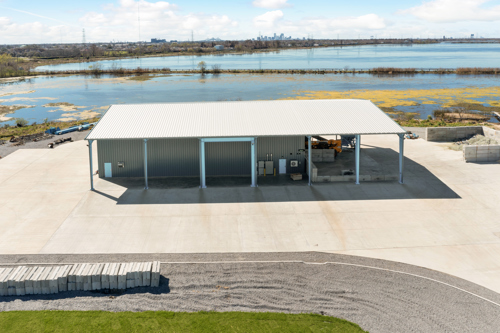
The company's massive new processing facility in Louisiana.
Today, Glass Half Full is expanding beyond glass into broader recycling services —cardboard, paper, plastic, aluminum — in pockets of the Southeast and hopes to continue expanding its geographic footprint throughout a region where recycling is often an afterthought.
When she started the company, if she had known then what she knows now — about all the frustrations and doubt and roadblocks and painstaking work that lay ahead — she is not sure she would have taken the same leap she did after that first bottle of wine. “If I had the idea for Glass Half Full today, I do not think we would have actually pursued it to the same degree,” she says. “Because we would have known more. We would have said, ‘Oh, all these things could go wrong and that is why you should not do it.”
Instead, she clung to an idea that inspired her, learned on the fly, and built something sustainable, all while serving the environment in the region she cherishes. A glass half full, indeed.
Interested in becoming an EO member like Franziska? Learn more here.
 More EO Member Journeys

EO’s Best of 2025: Inspiring Entrepreneurial Journeys
A collection of our most-read and most-compelling EO member profiles from the past year.

How Entrepreneurs’ Organization Helped Brian Scudamore Turn a Junk-Hauling Idea Into an International Powerhouse
From borrowing quarters for an empty parking meter to leading a near billion-dollar business, the 1-800-GOT-JUNK? founder credits his EO community for giving him a place to learn, grow, and give back.

Data and Defiance: One Woman’s Rise from Obscurity to Silicon Valley Success
Engineer-turned-analyst-turned-entrepreneur Sindhu Srivastava (EO Silicon Valley) built thriving businesses, found belonging in EO, and is now focused on empowering girls to learn to lead.