
 Login
Login


EO's Stanford AI Integration Lab Attendees Share Takeaways from the Inaugural Program
April 15, 2026
Published in:
EO members gathered for an immersive executive education program at Stanford Graduate School of Business to explore how artificial intelligence is reshaping strategy, operations, and leadership. Through hands-on learning and peer collaboration, participants left with practical roadmaps to redesign their companies for the AI age.

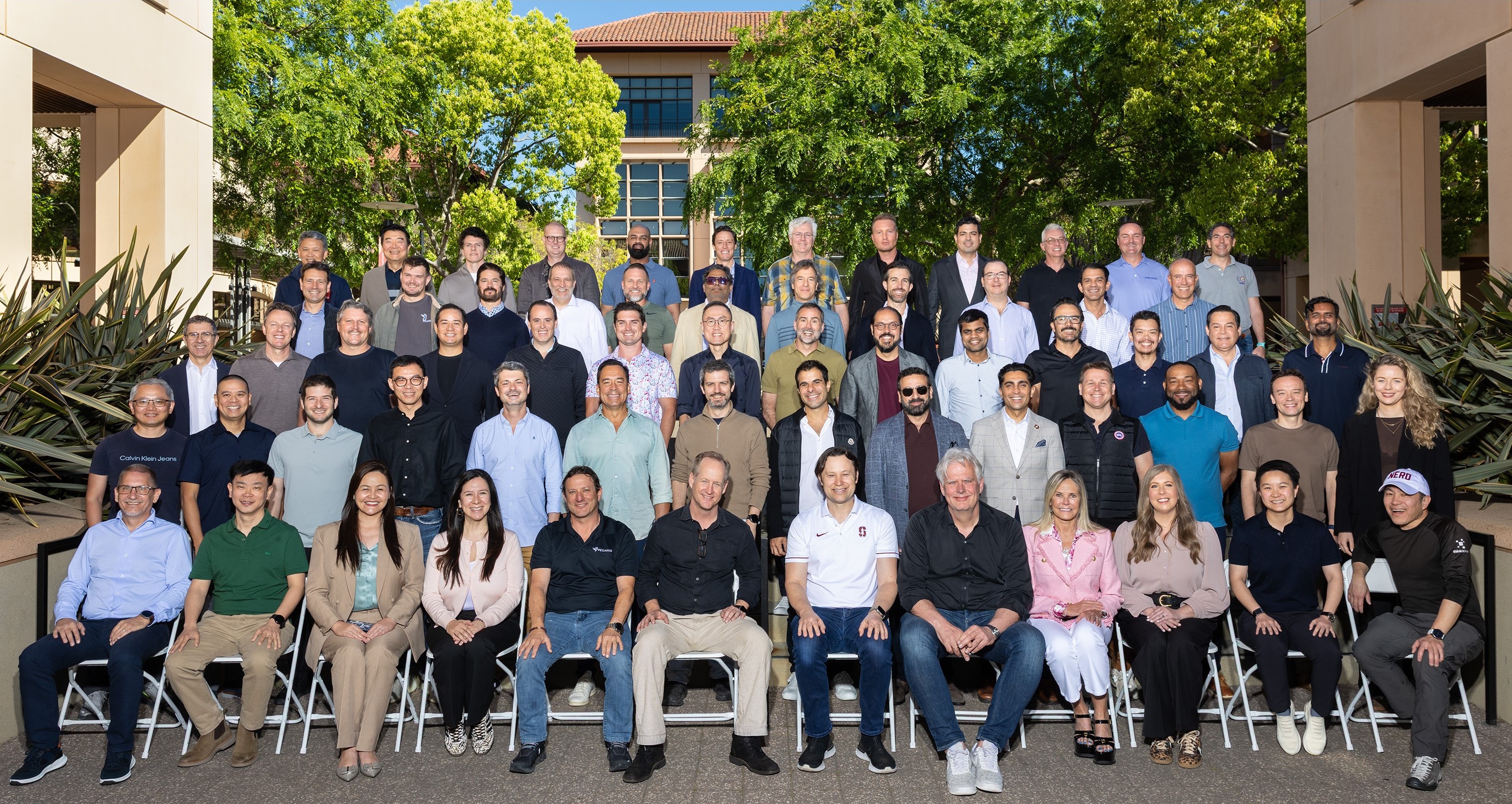
Artificial intelligence has quickly evolved from a futuristic concept into a present-day leadership priority. Determined to stay ahead of its rapid evolution, EO members realize that AI will reshape their businesses, and want to learn how to integrate the technology with intention and confidence.
That urgency drew 63 EO members to the renowned Stanford Graduate School of Business (GSB) in the heart of Silicon Valley for an inaugural executive education program, EO Stanford GSB: AI Integration Lab, from 23-27 March 2026.
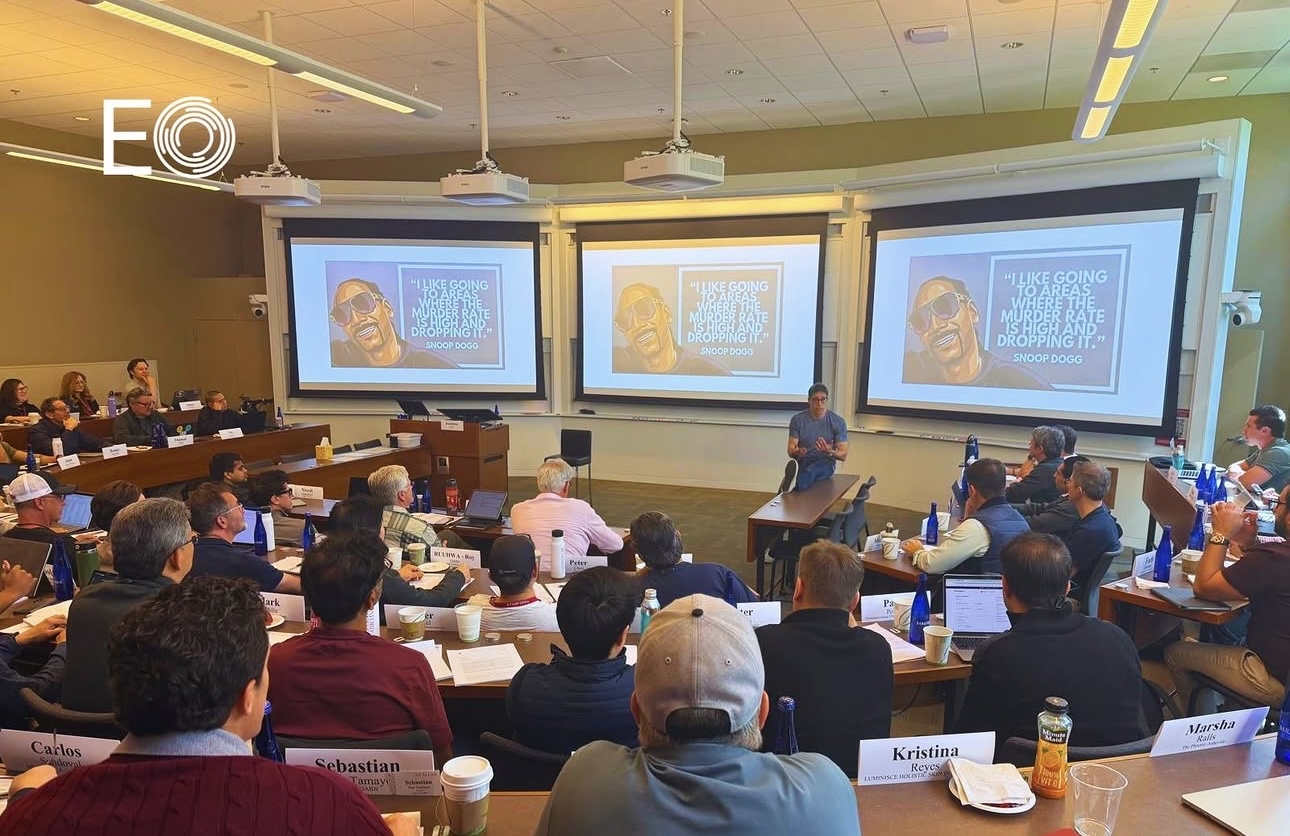
Moving beyond theory and into real-world application, the sessions and guest speakers focused on everything from the history of AI to the rise of agentic systems and multi-agent teams. Attendees explored how AI is reshaping decision-making, innovation, workforce strategy, and governance. More importantly, attendees left with practical tools and a roadmap to apply immediately within their companies.
“Before attending, I was primarily thinking about how to future-proof my existing business and help my team build skills needed for the age of AI,” said Peter Chee, EO Seattle. “What became much clearer during the program is that using AI as a tool is not the same as becoming an AI-native company. That distinction was a major unlock for me. It pushed me beyond asking, ‘How do I protect what I have?’ to asking, ‘How do I redesign the company for what is next?’”
Ryan Villanueva, EO Boston gained similar insights. “I went in thinking AI was a productivity tool — but my mindset shifted. The program asked us to question, ‘Why does a company exist?’ and ‘If I could re-design my company in the age of AI, how would I do it to grow faster, be more profitable, and be more impactful?’” he said. “It became clear that the real opportunity — and the real risk — is in how fundamentally AI can reshape what a business does, not just how it operates.”
We asked attendees of the inaugural EO Stanford GSB: AI Integration Lab program to share what surprised them most, what challenged their thinking, and what they are already putting into practice back home:
What takeaway from the EO Stanford AI Integration Lab will you implement in your business?
“Rather than building around one model, I am creating an LLM-agnostic framework that can evolve as the technology evolves, whether that means using frontier models from OpenAI, Anthropic, and Google or local models. That flexibility keeps us from being locked into a single provider and allows our business to adapt as capabilities improve. The program reinforced for me how important our own proprietary data is. That is the real asset. AI can create leverage, but the moat comes from combining it with the unique data and workflows inside your company.” — Peter Chee, EO Seattle, founder of Thinkspace
“One key takeaway not related only to AI is that as we add new things, make sure to also take things off. So, as you continue to add more AI tools and more AI expectations, make sure to also remove some things to create space for it.” — Tyler Lang, EO Cincinnati, founder of Journey Advisory Group
“I will implement an AI agent that understands my full context as an entrepreneur — not just one business, but all of them, simultaneously. I am a partner at a consulting firm, a majority owner of an education company, and a board member and operator at a beverage brand. If I give AI the right data, it can help me stay on top of all of it at once. That is the new leverage I am building: A personal operating system powered by AI that reduces my mental load across every business I touch.” — Ryan Villanueva, EO Boston, co-founder of Best Delegate
“My key takeaway is that my strategic advantage is actually not going to be in competing with AI, but in what AI cannot do. So, I'm definitely going to implement AI to be more efficient. But on the product side, what differentiates me from other companies is my community and trust.” — Veerle Smit, EO Netherlands, CEO of Compendium Medicine
How did the program reshape your thinking about strategy—not just technology—in the age of AI?
“AI is about prediction, not only automation. We tend to think it is more about automation, but it is prediction.” — Sergey Zhuravlev, EO Russia, co-founder of Kavanga
“Before the EO Stanford AI Lab, I thought about AI at the task level — Which things can I automate? Now, I am thinking about it at the company level — Should I relaunch this business as an AI-first company? That is a completely different strategic question.” — Ryan Villanueva
“Receiving direct instruction from Stanford faculty felt like my brain was being ‘rewired’. We were given a specific Stanford framework for transformative thinking to apply. My strategic shift was realizing that winners will not just adopt AI faster; they will fundamentally rethink their business models, organization structure, operating systems, and customer experiences.” — Peter Chee
What is one big-picture lesson from the program that any entrepreneur could apply right away?
“AI is an experiential technology. Similar to how you can read about swimming but you cannot actually swim unless you jump into the water, you cannot understand AI only by reading about it or waiting until it feels more settled. Run experiments. Build something small. Use it to solve a real problem inside your company. Even a simple workflow improvement that saves 30 minutes a day can compound into meaningful leverage over a year. The big lesson is to stay curious, stay flexible, and start learning by doing. No one has it all figured out yet; that creates opportunity for entrepreneurs willing to engage early.” — Peter Chee
“Stop asking ‘How can AI help my business?’ Start asking, ‘What business am I actually in, now that AI exists?’ Those are different questions — and the second one is more important. Every industry is being redefined by what AI makes possible, and what it makes obsolete. The entrepreneurs who move first on that question will have the clearest view of where to invest and where to get out of the way.” — Ryan Villanueva
What stood out to you about learning alongside other EO members?
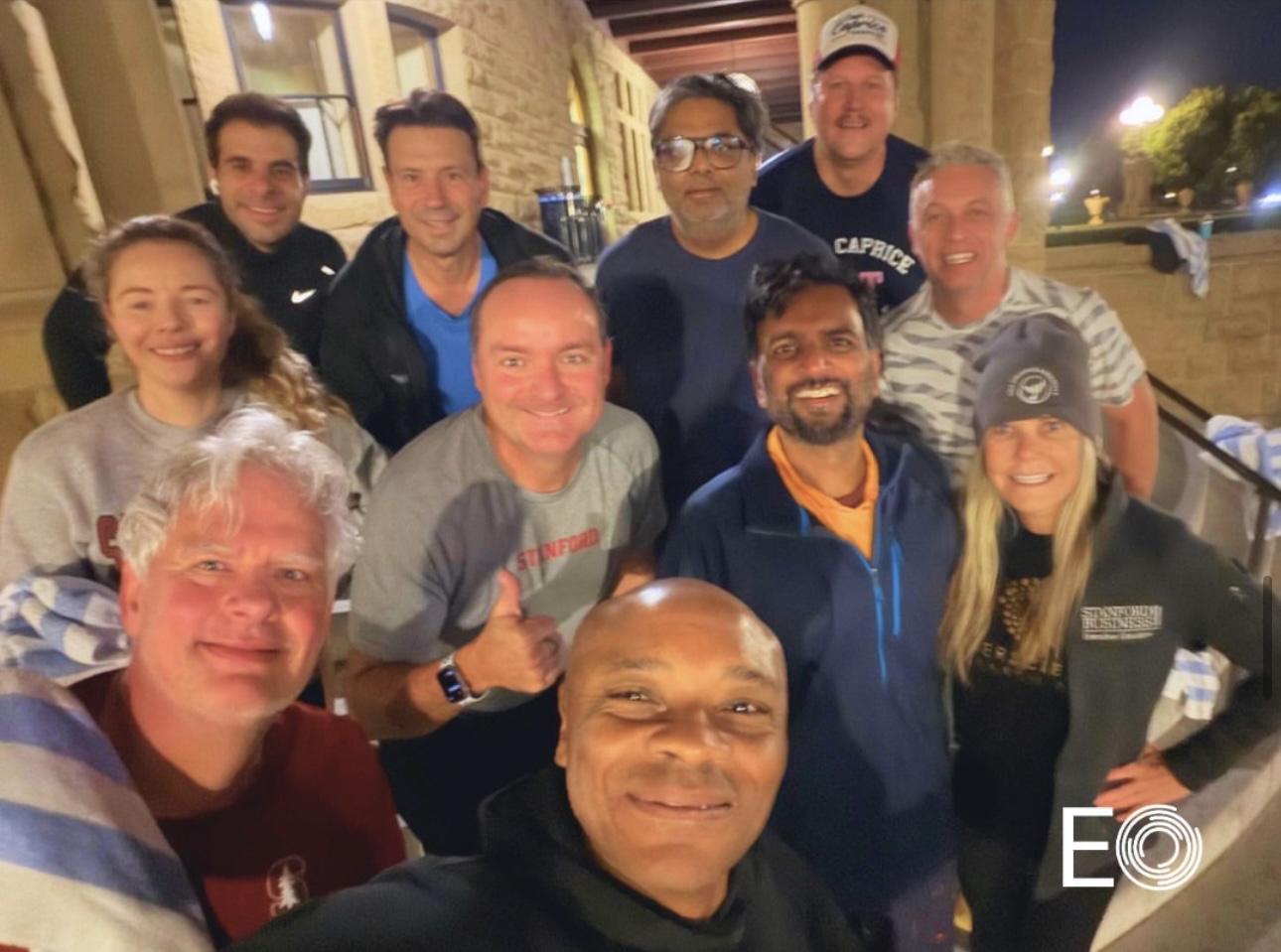
“The Stanford faculty was exceptional, but what made the experience truly unique was learning alongside a room full of EO members who are building meaningful companies across industries, markets, and countries. In effect, you were surrounded by live case studies. That created an extraordinary learning environment because the insights were practical, current, and grounded in real businesses.” — Peter Chee
“Hearing EO members from different countries and industries describe how they are deploying AI made the learning immediately actionable. One person's experiment became everyone's data point. The global mix mattered: AI adoption looks very different in markets with different labor costs, regulatory environments, and tech infrastructure. That diversity of context pushed my thinking beyond what I would have gotten in a purely U.S.-focused room.” — Ryan Villanueva
What would you share about the value of the experience with another EO member who is considering attending the Stanford AI Integration Lab?
“It was a 10 out of 10! The program gives you something most executive education does not: range. You get academic frameworks, technical depth, and peer-level case sharing from EO members in real businesses. If you are wondering how AI will impact your industry, this program will not only answer that question — it will help you figure out what to do about it. And that is exactly why I am in EO.” — Ryan Villanueva
“AI is happening now. We all have a huge, massive opportunity. The great group of EOers and learning from them, the real application, real challenges, and firsthand insights challenge you to think bigger and faster.” — Fadi Baransi, EO Jordan, CEO of BCI Smart Technologies
“This program helps you think at the right level. It is about understanding how this technology could reshape your business, your industry, and your role as a leader. We are still early, which means the opportunity is significant for those willing to learn, experiment, and adapt. I came away with not only new ideas, but also a clearer framework for how to move from curiosity to implementation. If given the opportunity, I would re-attend, because AI is evolving, and I love to learn from EOers who are transforming their companies.” — Peter Chee, EO Seattle
“The professors gave us so much great content and value. It was also meaningful to be with EO peers, some who were very experienced in AI, and others like me for whom this was new. I brought so much back to implement in my business.” — Marsha Ralls, EO Latin Bridge, founder of The Phoenix AshevilleOff-site link.
“I was hearing so much about AI from so many different people. I am an attorney. I did not want the law firm I run to be disrupted by AI and become the Blockbuster Video of the legal industry. I want to be the Netflix. So, I went to the EO Stanford AI Lab learn the necessary skills to be successful in AI.” — Salman Bhojani, EO Fort Worth, founder of Bhojani Law
“The program helped me see that the businesses that win in the next decade will not just be those that adopt AI the fastest. They will be the ones that rethink their value proposition, team structure, and revenue model around what AI makes possible. For me, that means asking a harder question: What does this company look like if we start from scratch, knowing what AI can do today?” — Ryan Villanueva, EO Boston
Related posts of interest:
- EO Global AI Summit 2026: Transforming to an AI-First Company
- Your AI Is Only as Smart as Your Data: 7 Mistakes Leaders Make When Combining AI and Analytics
- 5 Ethical AI Pillars To Ensure Responsible Use in Your Organization
- How AI Competitions Turn Curiosity Into Business Capability
- Why Most AI Projects Fail (And What Leaders Miss)