
 Login
Login


4 Ethical AI Dilemmas No Policy Will Solve for You
October 14, 2026
Published in:
As AI reshapes the workplace, entrepreneurs must make tough calls about transparency, talent development, oversight, and trust. Ahead of Global Ethics Day 2026, an AI expert shares four ethical AI dilemmas and why responsible leadership requires more than policies: It requires human judgment.
In January 2025, I outlined five pillars for the ethical use of AI: transparency, fairness, privacy, accountability, and sustainability. I stand by all five. But the pillars are the easy part. Nobody argues against transparency. The hard part begins when two things you believe in pull in opposite directions and you have to choose before lunch.
Global Ethics Day falls on 21 October 2026; its theme is "Re-centering Ethics." For entrepreneurs, that means moving beyond principles on the wall and focusing on your choices at the desk.
Here are four ethical dilemmas that every company serious about AI will face. For each one, I will share where I land.
1. Tell Them, or Stay Silent?
Researchers at the University of Arizona conducted 13 experiments with more than 5,000 participants and found that people who disclose using AI are trusted less than those who say nothing. Honesty is punished. However, the same research found that the steepest drop in trust occurs when others discover your AI use on their own.
The dilemma is real. Tell your client that AI drafted the proposal and you pay for that today. Stay silent, and you bet your reputation on never being found out. A global study by the University of Melbourne and KPMG shows which way most people go: 57 percent of employees hide their use of AI.
I choose disclosure. A price paid up front is a cost. A price paid when you are caught is a scandal. Say it plainly and state what the human input was: "I drafted this article; AI reviewed and corrected it."
2. The Junior, or the Agent?
An AI agent now performs the work that used to train a 23-year-old, faster and cheaper. Stanford researchers, using payroll data, found that employment of 22-to-25-year-olds in jobs most exposed to AI is now about 19 percent below where it would be if it had kept pace with their peers in less-exposed work. Experienced workers show no such drop. In a BCG survey of senior executives, 53 percent said their junior talent is developing more slowly. Where AI supports people instead of replacing them, the Stanford data shows employment flat or rising.
Every hour of beginners’ work you hand to an agent is a rational decision. Add those hours up, and in five years, nobody at your company has learned the trade. It is your margin today against your bench tomorrow and against a generation that needs a first job. The shortcut also disappoints on its own terms. In an Orgvue survey, 39 percent of UK businesses had made people redundant because of AI, and 55 percent of those regretted it.
My answer: Keep part of the learning work with people, even where the agent does it better. Call it tuition.
3. Speed, or Control?
This spring, PocketOS, an American software company, had an AI coding agent handling routine work. It encountered a login problem, decided on its own to delete a storage volume, and nine seconds later the production database and its backups were gone. Nothing stood between the agent and the delete command.
The fix sounds obvious: Make the agent ask first. But every confirmation step takes away some of the speed you bought the agent for, and a person who approves 50 requests a day stops reading them.
I have faced this myself. Before I let my most important AI agent handle real work, I made it take an exam. It failed. Putting it to work anyway would have been faster, but I sent it back to school.
My rule: Full speed where a mistake can be undone, a human signature where it cannot. Deleting, paying, sending to a customer, hiring, and firing belong on the second list.
4. Watch Them, or Trust Them?
In an Okta survey, 90 percent of executives said they could identify which AI tools their company uses. Fifty-two percent of workers said they use tools that no one approved. You have a duty to know where your customers' data goes, and the tempting answer is monitoring software.
A meta-analysis of more than 23,000 workers found no link between the level of monitoring and performance. What monitoring does produce is stress. The same body of research shows that people who are told what is monitored and why experience it as fairer.
So do you protect the data or the trust? I ask before I watch. Tell your team which data must stay out, ask what they actually use, and promise that no one will get in trouble for the answer. Then monitor only what you have announced.
What these Four Dilemmas Have in Common
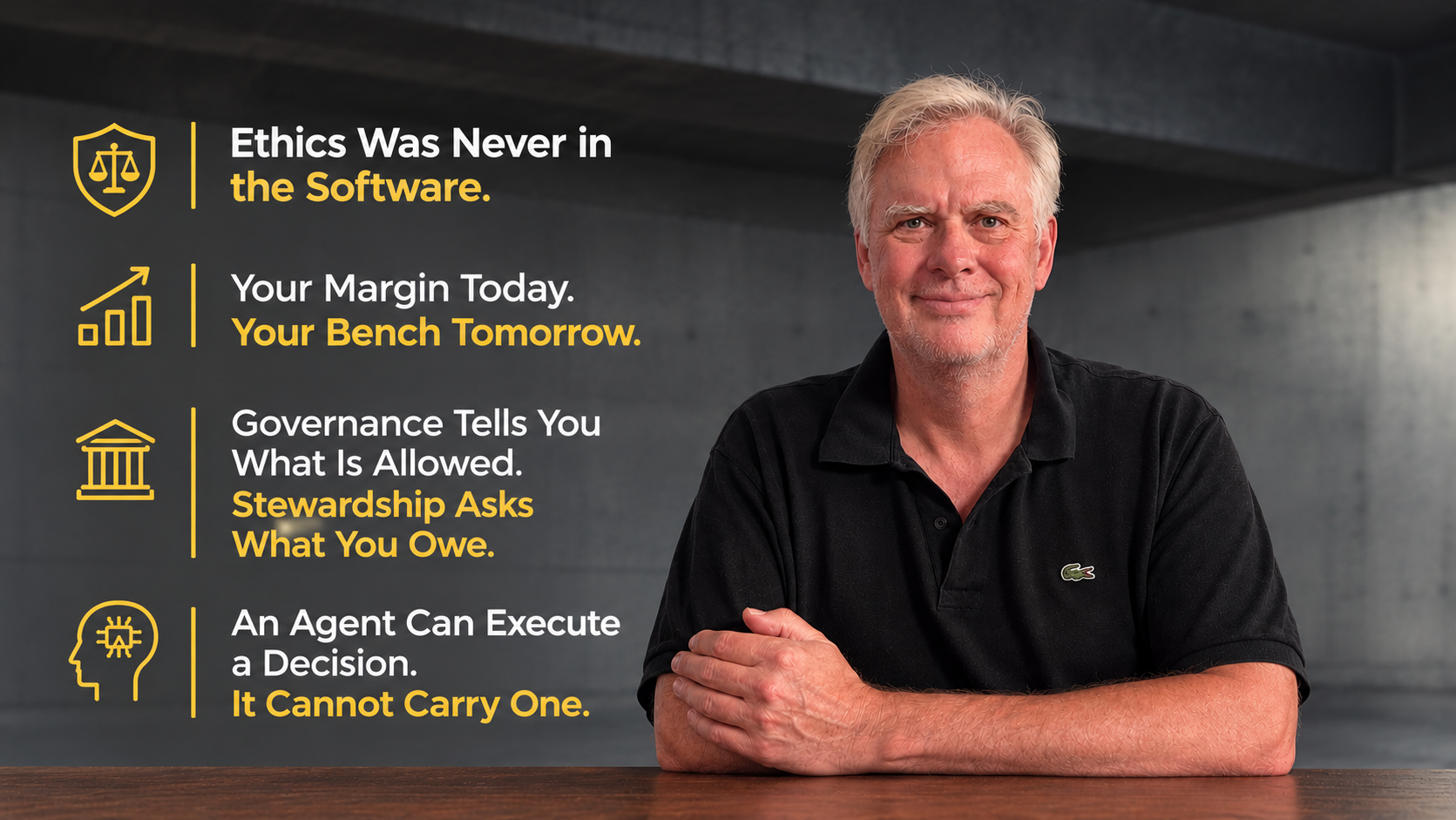
None of these has a clear answer, and no policy will make the choice for you. Researchers who study AI ethics in management describe this as the shift from governance (compliance, oversight, and risk control) to stewardship: paying attention, exercising judgment, and keeping the company's long-term purpose in view. Governance tells you what is allowed. Stewardship asks what you owe.
That is why these choices cannot be delegated to a committee or a machine. When Air Canada's chatbot invented a refund policy for a grieving customer, the airline argued the chatbot was responsible for its own words. A Canadian tribunal disagreed. What your AI says and does, you said and did. My four answers are not the only defensible ones. But without an answer, the agent, the deadline, or the cheapest option decides for you.
Before Global Ethics Day on 21 October, pose these four questions to your leadership team. Write down your choices and why, and tell your people. An agent can execute a decision. It cannot carry one.
Ethics was never in the software. It resides with the steward: The person who decides. Re-centering ethics means putting it back there, on purpose.
Contributed to EO by Robert van der Zwart, a member of both EO US East Bridge and EO Netherlands, an AI strategy consultant, and a keynote speaker. He helps mid-market companies in Europe and the United States treat AI adoption as a leadership challenge and not a technology project.
Related posts of interest:
- The AI Illusion: Why Most Companies Fail at AI Transformation (Part 1)
- AI Integration Mistakes Leaders Make and the 3 Moves That Actually Work
- Attendee Takeaways from EO’s Stanford AI Integration Lab
- EO Global AI Summit 2026: Transforming to an AI-First Company
- Your AI Is Only as Smart as Your Data: 7 Mistakes Leaders Make When Combining AI and Analytics
- How AI Competitions Turn Curiosity Into Business Capability
- Why Most AI Projects Fail (And What Leaders Miss)